
Rethinking Heroism in X-Men: Days of Future Past (2014)
By: Divya Shah
Introduction
The spectacle, the action, the inevitable triumph of good over evil; superhero films thrive on our expectation of an entertaining victory through extraordinary power.
However, over the past two decades, superhero cinema has evolved. Films like The Dark Knight (Nolan, 2008), X-Men: Days of Future Past (Singer, 2014) and Thunderbolts* (Schreier, 2025) have complicated the theme’s terrain, injecting movies with political reflection and emotional ambiguity. Even with A-list casts and blockbuster action sequences, the superhero is no longer just a saviour in a super suit, but a mirror for the human condition and a symbol of contemporary tensions.
Even in this currently developing landscape, most superhero films still offer some variation of the same climax, the final showdown: the triumph of good over evil through a definitive cathartic action scene. However, what makes Days of Future Past particularly distinct is that it resolves its apocalyptic tension through something subtler instead. At first glance, the plot of the X-Men sending Wolverine’s consciousness into the past seems like a typical time-travel superhero film. Yet beneath this plot lies a more nuanced struggle, not the battle between good and evil, but the internal reckoning of those who have lost faith in themselves and in humanity along the way.
This short article intends to explore how Days of Future Past differentiates itself from modern superhero cinema by subverting the expected climax of physical triumph. It contends that the film achieves this by reframing heroism through non-physical aspects such as self-restraint and emotional reconciliation. Moreover, it investigates how the climax hinges not on the mightiest mutant or a final duel, but on characters who learn to conquer their inner battles.
Context & Narrative
Days of Future Past sets the scene between two timelines: a future ruled by indiscriminating killer robots, the Sentinels, and a past where that apocalypse can still be averted. The movie also introduces the man behind the uprising of the robots: Bolivar Trask, the designer of the Sentinels and the public face of the anti-mutant crusade. So, Wolverine is sent back to 1973 with the sole mission to stop Mystique’s assassination of Trask, an act that would lead to her capture and the subsequent invincible enhancement of the Sentinels and hence, the end of the world. This overall premise frames the film’s moral tension between vengeance and restraint.
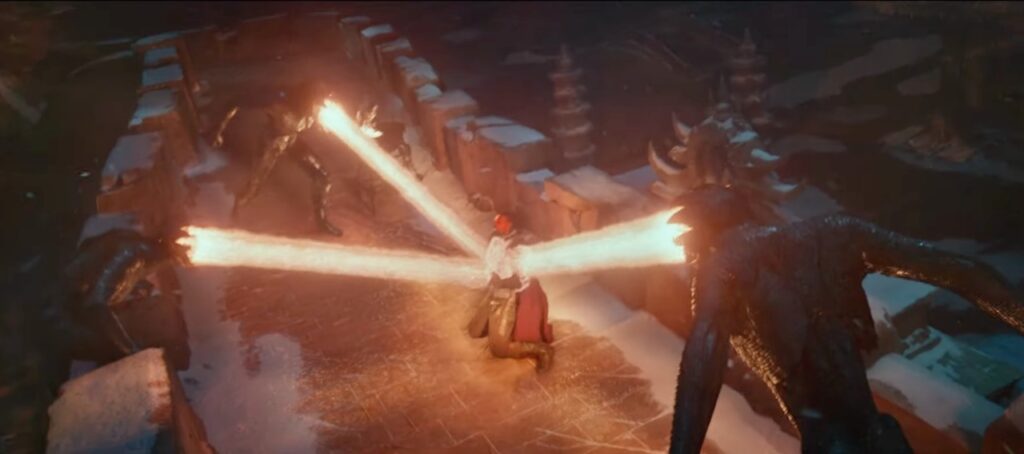
Anti-mutant robots, Sentinels, fighting and taking down some X-Men in the apocalyptic future
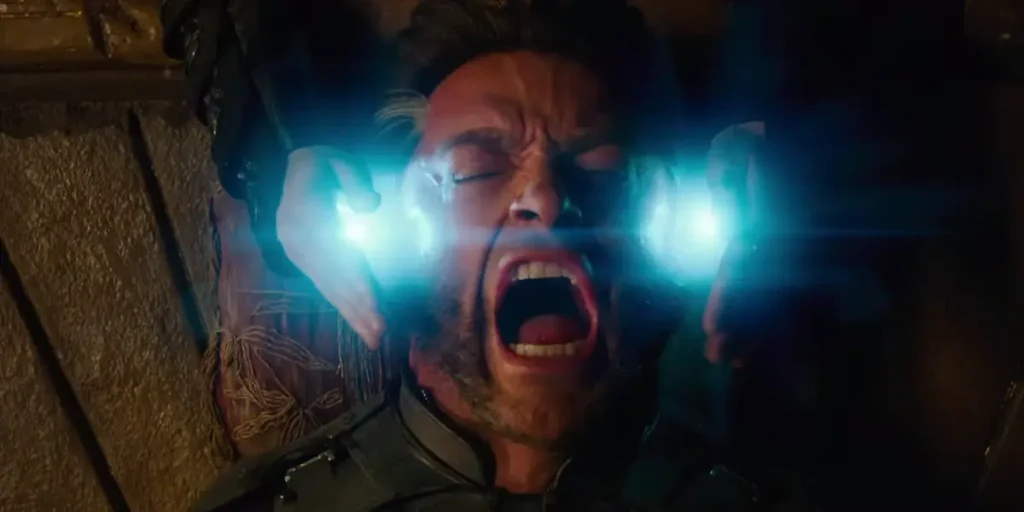
Wolverine being telepathically sent back into the body of his past self by Kitty Pryde
At the heart of this conflict stand Charles Xavier and Mystique, mutant allies who were expressing opposing responses to their grief and loss, after several mutants were murdered as part of Trask’s campaign. Xavier uses a serum drug to suppress his telepathic powers to feel less, withdrawing from his usual leadership, while Mystique channels her pain into retribution and hunts Trask. Each reveals a different way one’s power can be corrupted by negative emotion. Their eventual confrontation is what defines the film’s central focus. By examining these two, this article hopes to highlight how the film turns heroism inward, suggesting that the struggle for peace begins not in massive battlefields, but within oneself.
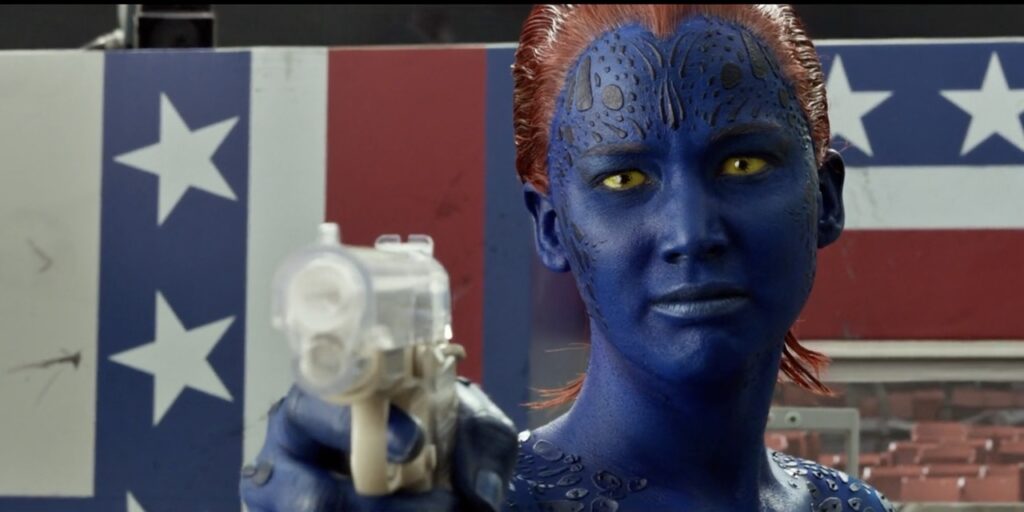
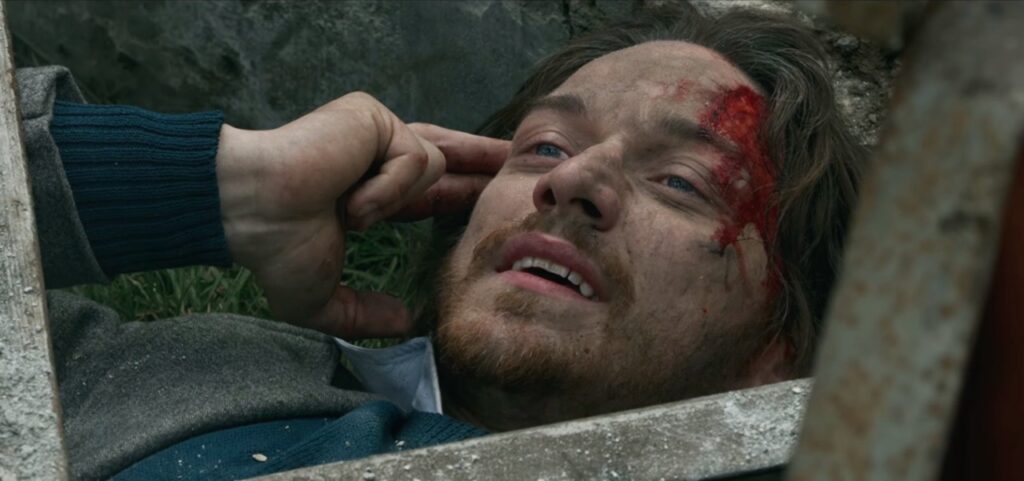
Xavier reaches out to Mystique, "I have faith in you, Raven", guiding her towards restraint
Charles Xavier’s Arc of Self-Reconciliation
Xavier’s redemptive journey demonstrates how heroism in the film materialises through introspection rather than a display of power. His struggle is illustrated as not against some villain but against his own paralysis and loss of confidence. When Wolverine first meets the young Xavier, he finds a man riddled with guilt for the mutants he had lost, numbing his powers with a serum that restored his ability to walk and feel more human. This trade visually captures his shunning of his responsibility as the leader of the mutants. The film compels the audience to observe how Xavier’s weakening is represented as an ethical crisis rather than a physical one, whether or not it is morally right for him to give up on the world. His turning point occurs in a telepathic exchange where his older self speaks to him, reminding him, “Just because someone stumbles and loses their way doesn’t mean they’re lost forever.” This conversation was a wake-up call for Charles to face his pain and weigh his choices. Thereafter, Xavier’s heroism begins to take flight, making his emotional courage the foundation for his motivation to lead again, to feel again.
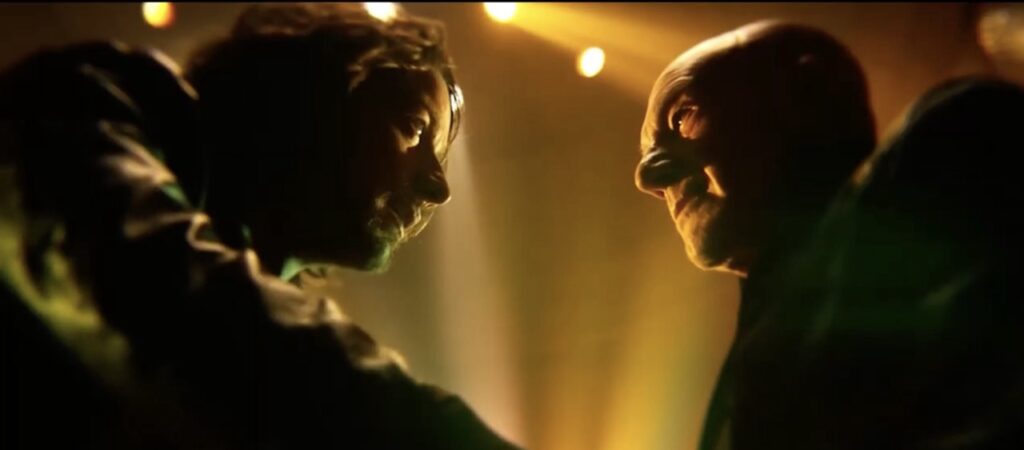
Older Xavier conversing with younger Xavier through telepathic powers
This pivotal scene is better understood through Hubert Hermans’ (2001) theory of the “dialogical self”. He defines identity as a dialogue between conflicting internal voices. Hermans explains that “the self is not a passive container of positions but a dynamic multiplicity of I-positions that are involved in dialogical relationships with each other” (p. 248). Relating this to the movie, Xavier’s two selves in the movie, the forlorn youth who refuses to help and the wise elder who has endured more loss and was facing an apocalypse, represent contending “I-positions”. This interaction of identities dramatises the “dialogical self” in a cinematic format, externalising the internal debate between despair and hope. The resolution of the two selves leads to Xavier’s moral rediscovery, where his guilt is not erased but transformed into purpose. The film, hence, allows Hermans’ abstract theory to become observable, showing that moral maturity can arise from discourse with various opposing versions of oneself.
This inner reconciliation restored Xavier’s leadership capabilities and brought about a drastic change in what his heroism means. His telepathic power, once a means of mind-reading and control, becomes an instrument of inspiring empathy because now his true power lies in his connection with emotion rather than control over others. After mediating his divided mind, Xavier was able to fight through his despair and eventually connect with Mystique in the climactic scene, where he convinces her to lower her weapon. Although this could be seen as a mere necessity for the plot, it illustrates the film’s rejection of physical domination as the measure of heroism by foregrounding the mutants’ emotional vulnerability as their main source of strength. Even movie reviewer Jex (2014) identifies that “The film implies that belief in yourself despite your failures is necessary for any hope for the future.”, indicating how the impact of the movie, as observed by viewers, is felt through Charles’ reconciliation beyond failure. Charles, getting back up after failure, coming out on top of his despair, chooses hope and instils that belief in Mystique too, marking his most crucial moment of heroism. Hence, he symbolises heroism grounded in reconciliation rather than aggression.
Mystique and her Heroic Self-Restraint
Similarly, Mystique’s narrative emphasises the film’s choice to depict restraint as her main form of heroism. Her defining act was not a battle but a moment of self-control: the decision not to kill Trask even though vengeance would be both justified and satisfying. To grasp why this restraint is framed so impactfully, we can turn to the psychology of heroism as discussed by Green, Van Tongeren, Cairo, and Hagiwara (2017). They articulate that “self-control or self-regulation is a critical component of the hero’s journey… especially critical when exercising virtue (or restraining evil, which sometimes may involve restraining one’s own selfish impulses)” (p. 516). Heroism is reinforced as a moral discipline, a framework that perfectly describes Mystique’s evolution. Throughout the film, Mystique is seen consumed by a hunger to prove her autonomy through violence. Trask’s murder would indeed avenge years of cruelty against mutants, but also affirm the very reasons that sustain that cruelty. Her struggle therein lies with herself, with the tempting notion that payback equals justice. Green et. al. further reinforce how “self-regulation may be the fuel that allows people to move from being potential heroes to actual heroes”. Mystique’s self-regulation was in that split-second ethical dilemma, where to abstain was not to surrender, it was to reclaim agency through control. In giving in to Charles’ words and resisting firing that gun, she symbolised a deeper heroism, a more abstract power: the will to choose restraint over reaction.
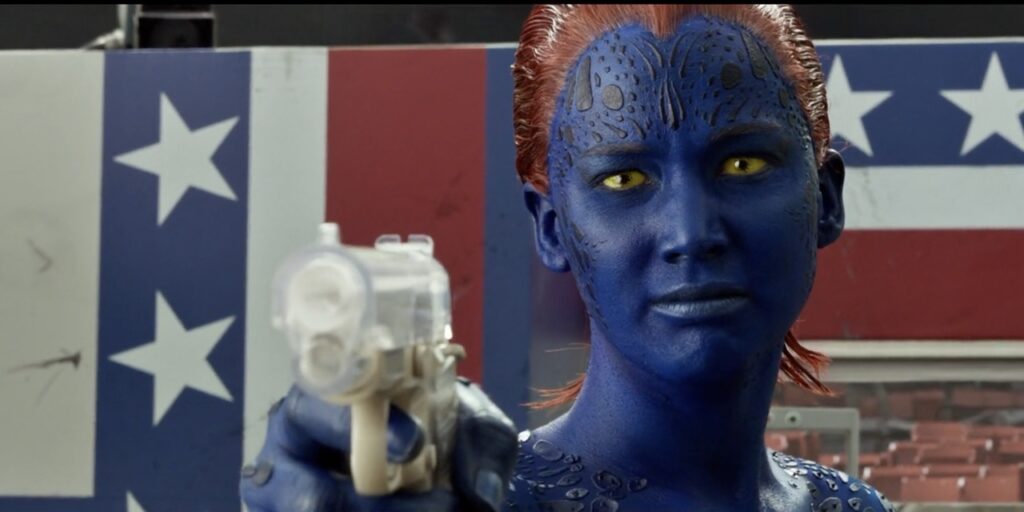

Mystique lowering her gun after Xavier's persuasion and her own choice of restraint
The camera lingers on her teary-eyed face during this hesitation, prolonging the silence to make her inner turmoil visible. Her aggression leaves, and instead, her self-control becomes the spectacle. Her facial expressions mirror what Green et al. (2017) describe as “heroic self-transcendence,” a movement from personal motives toward a greater-good awareness. Furthermore, as Bearden (2014) observes, the film “espouses the idea that bloodshed only leads to more bloodshed,” and so, Mystique’s hesitation before killing Trask exemplifies that the resistance to avenge becomes the highest form of heroism, transforming unnecessary violence into hope. Finally, Mystique revives the chance for coexistence between species, becoming someone capable of protecting the future rather than punishing in the present. Seen through this lens, we also see why Mystique’s decision feels unusual for superhero cinema. It questions the genre’s reliance on an entertaining display of action by treating the scene of restraint itself as the most observable and honourable gesture in the movie. Hence, heroism, in this context, becomes an act of doing less harm: the refusal to physically dominate, to perpetuate the cycle of fear.
Conclusion
In X-Men: Days of Future Past, the unique take on heroism culminates as a result of two character trajectories. One of the rediscoveries of faith in himself and others, while the other of the sacrifice of her vengeance for the greater good. Their intersection challenges the usual superhero format of satisfying victories and instead shows the film’s resolution being achieved through mastering oneself and one’s emotions. When Mystique lowers her weapon, her restraint becomes an extension of Charles’ rekindled hope, together showing redemption not as conquest but as moral discipline, positioning the saving of the world as a result of saving oneself rather than through the defeat of an enemy.
In an age saturated with reminders of conflicts, whether geopolitical or ideological, this film’s focus on the self highlights a novel significance. Both main characters’ resolutions gesture toward a model of heroism based upon mutual recognition and moral responsibility rather than a destructive spectacle. The film thus takes part in a contemporary discourse that restructures heroism as the willingness to empathise and forgo violence even when it seems right. Days of Future Past ultimately shows superheroes not as saviours who re-establish order through a show of might, but as respectable figures who embody the power to keep in touch with their emotions and who exercise self-control. As a result, it implores viewers to see that in a fractured world like ours, the subtle work of feelings may be the most notable and radical act of heroism.
References:
Bearden, W. (2014, June 10). Blessed are the peacemakers: A review of X-Men: Days of Future Past. Christ and Pop Culture. https://christandpopculture.com/blessed-peacemakers-days-future-past-review/

Green, J. D., Van Tongeren, D. R., Cairo, A. H., & Hagiwara, N. (2016). Heroism and the pursuit of meaning in life. In S. T. Allison, G. R. Goethals, & R. M. Kramer (Eds.), Handbook of heroism and heroic leadership (pp. 181–200). Routledge. https://doi.org/10.4324/9781315690100

Hermans, H. J. M. (2001). The dialogical self: Toward a theory of personal and cultural positioning. Culture & Psychology, 7(3), 243–281. https://doi.org/10.1177/1354067X0173001

Jex, M. (2014, June 3). A meditation on violence and prejudice, "X-Men: Days of Future Past" is the best X-Men movie yet. Hardwired for film. https://matthewjex.wordpress.com/2014/06/03/x-men-days-of-future-past-review/

Nolan, C. (Director). (2008). The dark knight [Film]. Warner Bros. Pictures; Legendary Pictures.

Schreier, J. (Director). (2025). Thunderbolts* [Film]. Marvel Studios.

Singer, B. (Director). (2014). X-Men: Days of future past [Film]. Twentieth Century Fox; Marvel Entertainment.