The Reconstruction of Hope in Spider-Verse Films
By: Too Charisse
Introduction
Contemporary superhero cinema operates according to what Coogan identifies as a “heroic character with a selfless, prosocial mission”. In such texts, hope typically functions as faith in the restoration of disorder, or a sense of optimism toward a possible, albeit uncertain, outcome that the superheroes desire (Gorichanaz, 2022; Bloeser & Stahl, 2017). Such a hope is thought to be relatively unproblematic, and even productive, for it drives superheroes to act for the greater good. Spidermen texts are, in that sense, no different. However, something unique to the franchise is what fans and creators alike term canon events—“chapters that are part of each Spider’s story, every time” (Spider-Man: Across the Spider-Verse)—predetermined moments that constitute the making of every Spider-Man (The Amazing Spider-Man, 2012; Spider-Man: No Way Home, 2021), where any change in the canon would risk the collapse of the Multiverse (essentially parallel universes).

Spider-Man jumping out of a glitching/collapsing Spider-Verse
On the surface, the Spider-Verse movies—Into the Spider-Verse (2018) and Across the Spider-Verse (2023) appear to subscribe to the same aforementioned superhero narrative of hope, and abide by the same Spider-Man canon. In these texts, the protagonist, Miles Morales holds on to a hope for a safer Earth-42 (his world) saving it from villains. However, upon further scrutiny of the Spider-Verse movies, we realise that the introduction of Miles Morales serves to disrupt the conventional pattern of hope in the typical Spider-Man text—for he was an “anomaly” and never meant to experience canon events, thus allowing for Miles to be the new locus of hope in the Spider-Man franchise: not one ‘bitten’ of destiny, but one carved from defiance against the canon. In doing so, Miles embodies hope as a drive for resistance—to enact an alternative path in the face of a seemingly fixed future. Thus, this essay serves to show the reconstruction of hope in the Spider-Verse movies, showing hope as a double-edged sword in Miles defiance against the fatalistic outcomes that the Multiverse’s canon puts him through—while hope is his fuel to form his own desired future, he inadvertently puts himself and the whole world at risk.
Reconstruction of Hope embodied by Miles Morales in the Spider-Verse
This short article explains how hope is reconstructed in the Spider-Verse films, which begets the need for an analysis of how hope is typically portrayed, and subsequently how the Spider-Verse films work to reshape it into one that helps Miles escape a predetermined trajectory. In contemporary superhero texts, hope is frequently constructed as a driving force bridging despair and resilience to a better future. In doing so, it provides an optimistic lens through which the characters see a possibility in restoration after catastrophe. For instance, in films like Avengers: Endgame, hope manifests through acts of self-sacrifice that signify faith in a future worth saving – a virtue represented by heroes like Captain America and Iron Man, who embody perseverance and idealism even amid loss. However, this drive to save the world paradoxically becomes hope’s hamartia in traditional superhero narratives. When hope is tied exclusively to sacrifice and restoration, it risks normalizing trauma as necessary rather than tragic. In their pursuit of better futures driven by hope, superhero texts inadvertently frame hope as a justification for repeated trauma, romanticising unnecessary loss. Under these circumstances, the hero holds on to hope despite losses as they believe that their sacrifice is meaningful – an example being Batman’s continuous fight against Gotham’s criminality even as it repeatedly destroys him. Traditional superhero hope, thus operates within a fatalistic framework that paradoxically demands suffering as the price of salvation.
However, as evinced in the introduction, the relationship between Miles and canon events set Spider-Verse texts apart from the typical superhero fare. In the Spider-Verse series, Miles’s origin story deviates from the standard Spider-Man trajectory, positioning him as what Miguel O’ Hara[1] calls “an anomaly”—someone who “[doesn’t] get it” precisely because he was never supposed to be Spider-Man at all. This deviation is crucial because it liberates Miles from the canonical logic that binds other Spider-People to predetermined suffering. Since Miles exists outside the canonical structure, the catastrophic consequences that follow when Spider-Man defies canon events, such as the Multiverse falling apart, do not materialize when he breaks the rules. The narrative thus constructs Miles as an interloper within a Multiverse that insists upon order and keeping to the canon. Through Miles, the fatalistic structure of the canon in the Spider-Verse is unsettled as we are offered with an alternative perspective into challenging the rules of the canon. Miles does not allow himself to be limited by the fatalistic structure of the canon, much less sacrifice anything for the canon, which works out given his different identity as an “anomaly”.

‘Nah, I’ma do my own thing’
Through his defiance against the canon, he embodies hope as a moral grounding – albeit one that was naïve and rash, putting himself at risk of danger. Miles embodied hope differently, as a conviction to change the trajectory of his future and pushes him to form his own identity.
Problematising Hope: Recklessness in Hope
With that, we can now address the problem of Miles’s reckless hope—a hope that drives him forward, yet simultaneously puts him in harm’s way. As aforementioned, hope is typically portrayed as optimistic and empowering in superhero narratives, and can be also seen as problematic when hope drives characters through unnecessary pain in their pursuit of a future they desire. However, Miles reveals how hope can become dangerous when divorced from careful judgement. Hope ultimately endangers because his intense desire to create the future he desires blinds him to the very real risks he faces. When hope becomes fixated on a desired future without a care for possible risks, it transforms from a motivational drive into a reckless force. This problematic nature of hope manifests throughout Miles’s journey as he repeatedly ignores warnings and his own limitations in the pursuit of his ideal future—mainly premised on his goal to save his father. McGeer identifies this exact phenomenon, arguing that hope becomes dangerous when the hoper miscalculates hope and abilities, failing to “take a regulative … stance” and instead prioritizing their fantasies over their abilities. This is supported by Milona’s chapter on the Philosophy of Hope, as he discusses hope as a “motivational force” that functions well only when properly attuned to reasons and realities – without this force, the character’s drive becomes reduced to a mere agency without any direction.
Similarly, reckless hope throughout his Spider-Man journey demonstrates how hope divorced from careful judgement becomes dangerously reckless. When hope fixates on a desired outcome without evaluating one’s actual capabilities or the warnings of others, it transforms from an empowering force into a hazardous impulse. His determination to defy the canon and save everyone (including his father) despite Miguel’s repeated warnings exemplifies what McGeer cautions against—the pursuit of a future-fixated fantasy driven by sheer hope with uncalculated risk. The danger of Miles’s hope-driven actions becomes even more pronounced when we consider his admitted inexperience with his Spider-powers. Throughout the film, Miles constantly acknowledges his unfamiliarity with his abilities yet simultaneously engages in extraordinarily risky behaviour: swinging from trees, leaping across buildings, and traversing the Multiverse to battle villains—all while operating on hope rather than mastery of skills.

Miles Morales jumping off of a building.
Miles’s father captures this recklessness when he remarks that Miles “does these things that are so stupid”, a statement that underscores how Miles’s hope operates faster than his judgement. This pattern reveals that hope, even when directed towards noble goals like saving the world or resisting fatalistic systems, can become problematic when it overrides rational thinking and risk assessment. Hence, Miles’s complete disregard for his limitations and others’ warnings suggests his hope has become untethered from reality, making him vulnerable rather than empowered.
Hope’s Role in Defying the Canon
With that, Miles’s hope, though reckless and naïve, becomes the necessary catalyst for disobeying the canon’s fatalistic constraints.
In the Spider-Verse films, Miles’s narrative arc centres around his refusal to allow inevitability to dictate his circumstances.
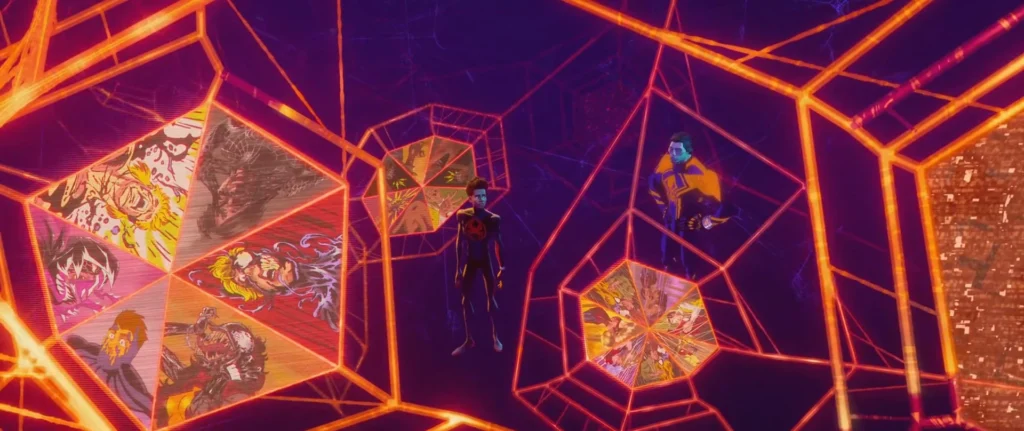
Miles Morales staring at the intersections of events in the Spider-Verse – the canon
He clutches onto a hope for a future he desires, not limiting himself to the boundaries of the canon. Despite Miguel O’Hara’s insistence that he cannot do anything to change what is predetermined by the canon, Miles maintains his determination to forge his own path. This unwavering commitment to a desired future, even when told it is impossible, distinguishes Miles’s approach to hope from traditional superhero narratives.
Here, Miles’s journey aligns with the concept of cruel optimism (Berlant, 2011), where he becomes attached to a fantasy that promises fulfilment but simultaneously forecloses it. Berlant theorises cruel optimism where a subject’s hope drives their pursuit of a desired object or future, while simultaneously obstructing the very goal the subject is trying to reach. The idea of cruelty is manifested when the subject has to endure constraints or even sacrifice in reaching the utopia that they envision, which may not even happen given obstructions in their way. For Berlant, this cruelly optimistic subject continues striving towards the utopian life that is systematically unattainable, driven by a sheer hope in reaching their ideal future and in defying the odds stacked up against them, In the Spider-Verse, the canon is precisely this obstructive system that limits Spidermen’s mobility, foreclosing alternative pathways for Spidermen, even forcing the Spidermen to stomach sacrifices (in the case of Uncle Ben, Aunt May, Gwen Stacy’s deaths).
Miles’s determination in saving his father exemplified cruel optimism most clearly as it represent the films’ central conflict between attachment to an impossible goal and systemic forces insisting on its impossibility. This is premised on the fact that all Spidermen had to lose a loved one who played a huge role in their life to fulfil the canon in the Multiverse, as evinced by the limbo-state shown to Miles, where he found out that his father would die in two days. Miles faces the ultimate manifestation of cruel optimism here – he risks completely unravelling the Multiverse, yet cannot bear to let his father die. When Miguel makes Miles “choose between saving one person and saving every world” (essentially between saving his father and the world), Miles insisted “I can do both!”.
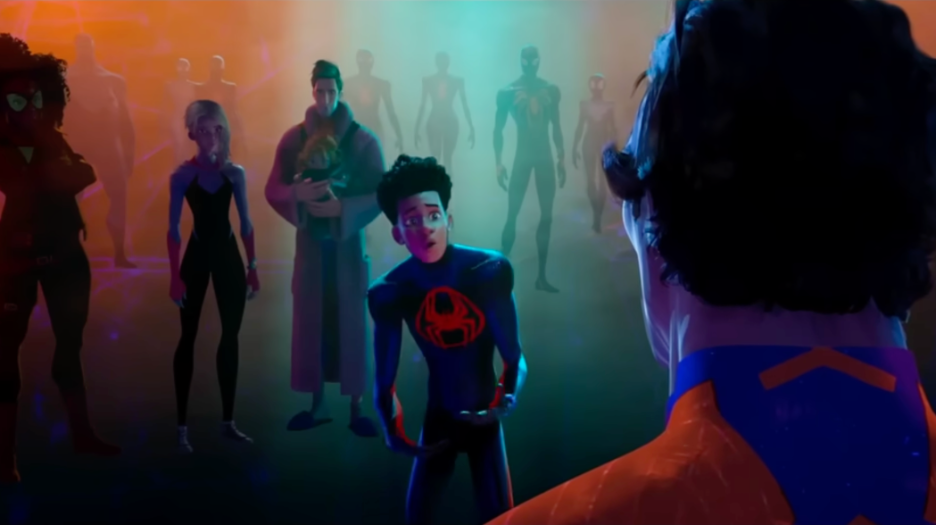
‘I can do both!’
Even when Miguel tries to stop him, Miles refuses the binary, asserting “I’m not asking. You can’t ask me not to save my father”. Here, the significance of cruel optimism rests in the idea of a pursuit driven by hope—Miles’s journey reveals the cruelty of clinging onto supposedly impossible dreams may be precisely what enabled his resistance against such deterministic systems. As such, Miles’s hope drives his determination to carve out a future that he wants, rather than to follow the other Spidermen and abide by the structural limits of the canon, though he knew the risks of going against it.
Conclusion
In conclusion, the Spider-Verse films present hope as a paradoxical force unlike the usual superhero narrative of saving the world and self-sacrifice. Instead, they serve to demonstrate how hope empowers Miles to resist the determinism of canon, yet a problematised view of hope simultaneously exposes Miles’s recklessness. His belief that he can escape a pre-scripted fate risks unravelling the Multiverse itself, exemplifying how hope can verge on cruel optimism when it blinds its subject to material consequences. However, Miles transforms that optimism into agency. As the show progresses, Miles realises the conflict between his ideals and the canon. Alas, “With great power comes great responsibility”—Miles starts understanding his responsibility given his new identity as Spider-Man: he needs to protect both his and the world’s needs. Given his Spider-powers, he eventually manages to leverage this drive fuelled by hope to ‘do both’: to save his father from impending death and to save Brooklyn, to juggle the responsibility of himself, his family and his world. Hope (when tethered to action) in the Spider-Verse can thus be aptly summed as a means of rewriting the structures that claim to be unchangeable.
Bibliography
Aronson, R. (1991). [Review of the book The principle of hope, by E. Bloch]. History and Theory, 30(2), 220–232. https://doi.org/10.2307/2505540
Berlant, L. (2011). Cruel optimism. Duke University Press. https://doi.org/10.2307/j.ctv1220p4w
Coogan, P. (2006). Superhero: The secret origin of a genre. MonkeyBrain.
Dos Santos, J., Powers, K., & Thompson, J.K. (Directors). (2023). Spider-Man: Across the Spider-Verse [Film]. Columbia Pictures; Marvel Entertainment; Sony Pictures Animation.
Gorichanaz, T. (2022, May 30). Theorizing information sources for hope: Belief, desire, imagination, and metacognition [Paper presentation]. CoLIS 11 Conceptions of Library & Information Science conference, Oslo, Norway. https://arxiv.org/abs/2206.03311
Lewis, T. G. (2016, March 24). The ageless appeal of superheroes: What effect do superhero stories have on audiences? Deseret news. https://www.deseret.com/2016/3/24/20585419/the-ageless-appeal-of-superheroes-what-effect-do-superhero-stories-have-on-audiences/
McGeer, V. (2004). The art of good hope. The Annals of the American Academy of Political and Social Science, 592(1), 100–127. https://doi.org/10.1177/0002716203261781
Milona, M. (2020). The philosophy of hope. In S. C. van den Heuvel (Ed.), Historical and multidisciplinary perspectives on hope (pp. 99–116). Springer. https://link.springer.com/chapter/10.1007/978-3-030-46489-9_6
Miles Morales (Earth-1610)/quotes. (n.d.). Into the Spider-Verse Wiki. Retrieved February 10, 2025, from https://intothespiderverse.fandom.com/wiki/Miles_Morales_(Earth-1610)/Quotes
Persichetti, P., Ramsey, P., & Rothman, R. (Directors). (2018). Spider-Man: Into the Spider-Verse [Film]. Columbia Pictures; Marvel Entertainment; Sony Pictures Animation.
Scott, A. O. (2018, December 12). ‘Spider-Man: Into the Spider-Verse’ review: A fresh take on a venerable hero. The New York Times. https://www.nytimes.com/2018/12/12/movies/spider-man-into-the-spider-verse-review.html
Watts, J. (Director). (2021). Spider-Man: No way home [Film]. Columbia Pictures; Marvel Studios.
[1] Spider-Man of 2099, also leader of the Spider-society that ensures the safety of the Spider-people through making sure that the Multiverse and its canon events are not compromised or broken.