by Truong Kim Mai
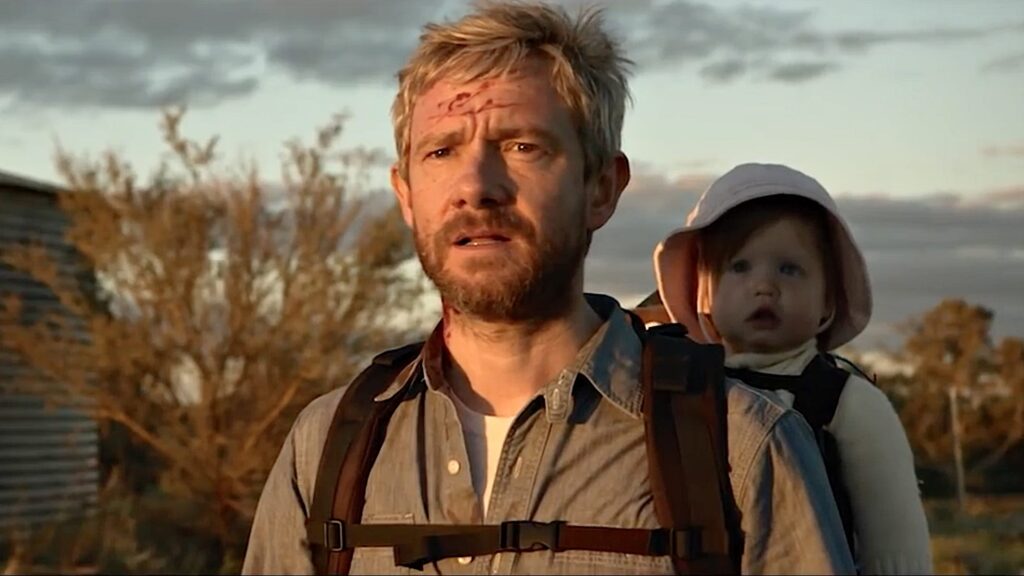
In movies about zombie apocalypses, society is often depicted as morally degraded, with humans becoming hostile, aggressive, and reverting to tribalistic, cannibalistic, and uncivilised ways of life. Within this context, the protagonist is often portrayed as subverting these norms, whether they initially possess such traits or develop them over time. They retain their empathy for others instead of only acting for their own interest and self-preservation. They resist the “survival of the fittest” mindset around them, choosing to risk their life to protect people around them. Their love for others is shown through acts of selflessness and affection. However, in situations where they have to decide between the survival of their loved ones and strangers, they often choose their loved ones. In Cargo (2017), the main character, Andy, has limited time to find a safe place for his daughter Rosie before he is turned into a zombie. Despite this, he continues to go out of his way to act selflessly for and extend affection to an Aboriginal girl with no blood relations to him, Thoomi, even if it means risking Rosie’s safety. Unlike other protagonists who have the time and strength to act altruistically but still prioritise their kin, Andy’s impending death heightens the weight of every choice, making his decision to love and care for a stranger an even more profound act of compassion that challenges the self-preserving logic of the post-apocalyptic world. Through this article, I will prove the weight of Andy’s selfless love and employ mortality salience to explain his behaviours.
The Last of Us (2023–) and The Walking Dead (2010–) are two of the most influential zombie apocalypse narratives, featuring protagonists who perform selfless acts of love and care. In The Last of Us, Joel risks his life at the end to rescue Ellie from being subjected to experiments. His decision is formed by grief and parental attachments, prioritizing love over utilitarian ideals. Similarly, in The Walking Dead, Rick Grimes constantly risks himself to save loved ones and preserve a fragile morality in a world of chaos and hostility. These acts of care and affection carry them through the apocalypse, rebelling against the survivalist mindset that has taken over their societies. They form this trope of a selfless protagonist that displays their humanity in an apocalypse about losing their humanity. However, they might not be as selfless when it comes to strangers. Joel and Rick protect a person/specific group of people, usually someone they have formed a familial bond with, and there are instances in both shows where, when the situation calls for it, they choose to protect their group over helping a stranger. Joel brutally murdered all the scientists at the facility Ellie was kept to save her. Rick abandoned strangers crying for help while running away with his family, like the hitchhiker with the orange backpack in Season 3. Just like the protagonists mentioned above, Andy is ready to do what it takes to ensure the safety of his loved one, his baby Rosie. His only mission set at the beginning is to find someone trustworthy enough to leave Rosie with, because he is inevitably going to turn into a zombie. What sets Andy apart from them is his care and affection for Thoomi, a stranger. He chooses to do so, although it would risk Rosie’s wellbeing. There are multiple evidences of this throughout the movie.
The movie begins with a family of three, Andy, Kay, and their baby Rosie. In this apocalypse, you have 48 hours after a zombie bites you before you turn into one. Kay is bitten, then, when she turns, she attacks and bites Andy. With less than 2 days to live, he has to embark on a mission across the desert of Australia to ensure Rosie’s future safety before it’s too late. On his journey, he briefly encounters Thoomi, an Aboriginal girl hiding away from her community and surviving on her own in the wild. She keeps her zombified father close by in fear that her people will burn him in an effort to push back the apocalypse. They part ways after minimal interaction before meeting each other again as captives. Andy has been staying with Vic, the villain of the film. He embodies the brutal survivalist mindset of the apocalypse. He abandons people who have no use for him, hoards resources, and uses humans as bait to attract zombies. When Andy attempts to escape with a woman held captive by Vic, who promised to care for Rosie, he is thrown in a cage as bait and finds Thoomi, who has also been captured. Contrary to the cruel Vic, Andy remains gentle when talking to her and persuading her to help them both escape from the cage. He builds her trust by promising her that he will help her free “The Clever Man”, a spiritual leader from Thoomi’s Aboriginal tribe, from another cage. Afterwards, Andy has to sneak into Vic’s base to get Rosie back. Despite risking detection by a dangerous man, Andy chooses to steal Vic’s keys from his bedside table to fulfill his promise to Thoomi. What begins as a cooperation out of necessity quickly evolves into a bond of care. Even when they discover The Clever Man has escaped, Andy does not immediately part ways to continue his mission to ensure Rosie’s safety. Instead, he chooses to stick by Thoomi’s side until she reaches her safe place, where they discover that her zombie father has been killed and burned. Faced with her grief, Andy does not treat it as a burden or distraction, but takes some time to offer her emotional support in a fatherly manner, in the hope that she can let go of him instead of drowning in her own sorrows. When she insists on staying with her father, Andy respects her decision and walks away, mumbling in distress, “She’ll be fine.”
Without a cure for his condition, Andy has little time to ensure Rosie’s well-being. Every time he chooses to help Thoomi or extends gentle affection towards her, he is making a high-stakes choice as he delays his journey to ensure Rosie’s safety. Along their journey, he has the choice to abandon her and go his way, which could have bought more time for him and Rosie. He can choose not to get Vic’s keys, to go with her to find “The Clever Man” or to continue accompanying her. Even if it means straying from his path, he keeps his promise and goes beyond it. He ensures not just her physical but also her mental well-being. Even when he has to leave her behind and continue with his journey, it is not an easy choice, as he is shown to be anxious about her safety. This proves he has grown to genuinely care for Thoomi. His love for her is not out of hope for future companionship or any form of compensation. Thoomi cannot take care of Rosie for him, and she has not shown him any alternative that can help with his objective. Andy expects nothing from Thoomi, and loves her anyway, making his love for her unconditional.
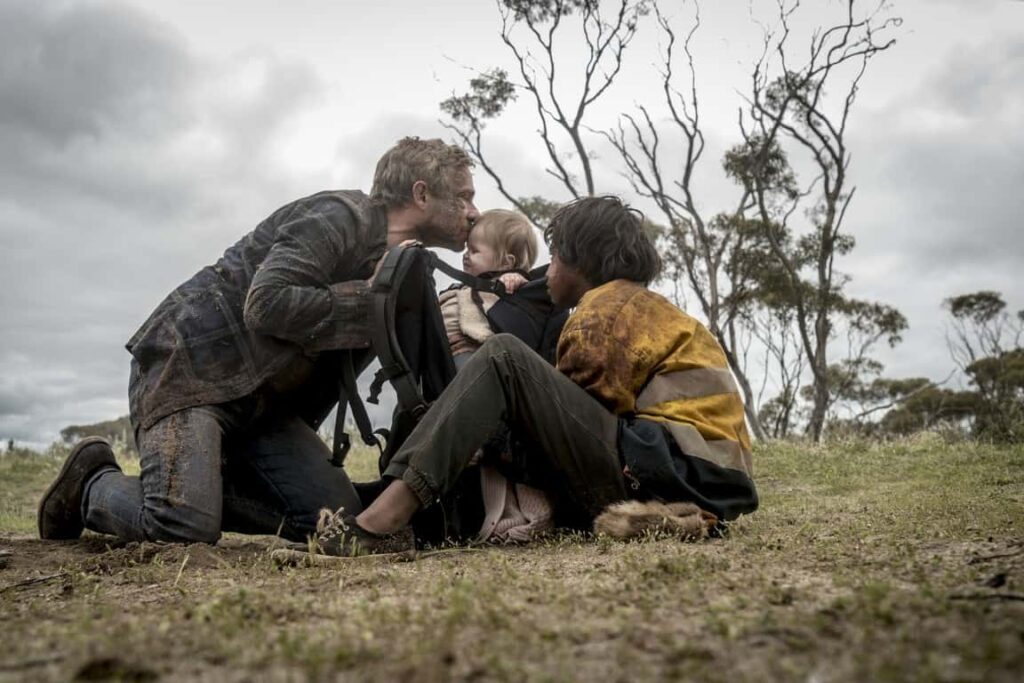
After a while, Thoomi chooses to keep following Andy and eventually reveals that she can bring them back to her community, where Rosie can be safe. However, Vic manages to track them down halfway through their journey and gives Thoomi a concussion in an altercation. They escape, but Thoomi has difficulty walking from her injury. The beginning of the end looms over the characters as they continue crossing the desert. Andy is visibly deteriorating as his infection advances; he is limping, and his vision blurs. Yet, he displays gentleness and care to Thoomi here, with a fatherly tone. He carries her as best as he can, whispering encouragements like “darling” and “good girl” and kissing her on the forehead. He does not lose patience nor urges her to hurry to their destination, even if it is her community that guarantees safety. Between his limited time and Thoomi’s comfort, he chooses to embrace this girl with every last bit of affection he has. While these are small acts on the surface, they symbolise something much more profound: in the process of losing himself, both physically and mentally, Andy is affirming his humanity by acts of love that do not ask for any form of reward.
Mortality salience:
Andy’s display of love for Thoomi might seem illogical at first. To better understand how Andy’s unique circumstances – his inevitable transformation into a zombie – affects his decision-making, we can turn to the concept of mortality salience. The concept, rooted in terror management theory, refers to the psychological state where a person is made aware of the inevitability of their death. When they are faced with impending death, they tend to reaffirm values that give meaning to their existence, such as through prosocial behaviours, defined as “acting in ways that are helpful, giving, and benevolent” (Jonas, Eva, et al. 2002). Mortality salience especially elicits prosocial and empathetic behaviours that align with held personal values. In the case of Andy, his fatherly affection towards Thoomi aligns with the parental love that he has been showing Rosie. His choices to care for Thoomi reaffirm his values as a father, to ensure his child’s physical and mental well-being, to hold them and calm them in terrifying situations. Further studies suggested that mortality salience makes people more emotionally driven and less utilitarian in decision-making when facing moral conflicts (Trémolière, Bastien et al. 2012). This shift means that, instead of prioritising efficiency or self-preservation, they act according to their compassion. This can explain Andy’s behaviours towards Thoomi, especially in his efforts to provide her with comfort and fatherly love even in moments of high risk and crisis. Andy’s deteriorating physical condition and limited time frame amplify his awareness of death to its most tangible form – sometimes he loses consciousness or experiences the urge to eat raw meat. Every decision he makes is shadowed by the countdown to his transformation. Yet rather than turning inward, hoarding all the time he has for Rosie alone, he expands his love and care to include Thoomi, someone he has no obligation to protect. His actions are not guided by utility, since helping Thoomi does not directly ensure Rosie’s survival; instead, they stem from a deep emotional and moral impulse to be good to people, even when it shortens his remaining time.
Conclusion
We often see zombie apocalyptic narratives celebrate selflessness and empathy through their protagonist. Cargo takes it a step further and portrays a love that does not cower in the face of one’s own demise but grows even stronger. Through the concept of mortality salience, we can understand Andy’s selfless love as an assertion of meaning in the face of annihilation, a refusal to let the apocalypse take away his humanity. In his final days, he chooses compassion and tenderness.
References
Howling, B., & Ramke, Y. (Directors). (2017). Cargo [Film]. Umbrella Entertainment; Addictive Pictures.
Jonas, E., Greenberg, J., & Pyszczynski, T. (2002). The Scrooge effect: Evidence that mortality salience increases prosocial attitudes and behavior. Personality and Social Psychology Bulletin, 28(10), 1342–1353. https://doi.org/10.1177/014616702236834
Trémolière, B., De Neys, W., & Bonnefon, J.-F. (2012). Mortality salience and morality: thinking about death makes people less utilitarian. Cognition, 124(3), 379–384. https://doi:10.1016/j.cognition.2012.05.011